
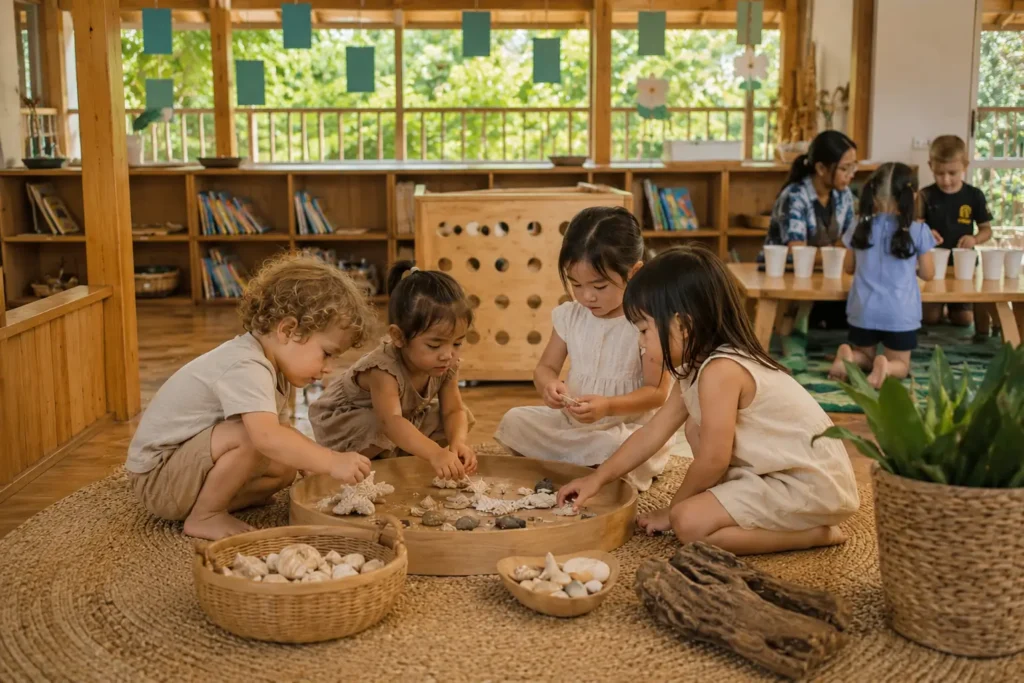
When people think about learning, they often imagine children sitting quietly at desks, listening carefully, and writing down answers. But in early childhood, learning can look very different.
Sometimes learning looks like children exploring an underwater world, asking questions about sea animals, experimenting with water, or using their imagination to create stories and ideas together.
For young children, learning is often most meaningful when it feels hands on, exciting, and connected to their natural curiosity.
Learning Through Exploration
Children are naturally curious about the world around them. They want to touch, investigate, build, mix, move, and discover how things work. This curiosity plays an important role in early learning.
When children explore topics through play and experience, they become more engaged and emotionally connected to what they are learning. An ocean investigation, for example, can lead to conversations about marine life, movement, textures, habitats, colors, and even caring for the environment.
These moments may look simple from the outside, but they support deep and meaningful learning.
The Power of Inquiry Based Learning
Inquiry based learning encourages children to ask questions, investigate ideas, and discover answers through exploration.
Rather than focusing only on memorising information, children are invited to think creatively, test ideas, and learn through experience.
Simple questions like:
- Why do some things float?
- How do fish move underwater?
- What lives in the ocean?
- Why is the sea important?
can open the door to rich conversations and exciting discoveries.
When children feel involved in the learning process, they often develop stronger confidence, communication skills, and curiosity.
Learning Through Imagination and Play
Imaginative play is a meaningful part of early childhood learning. When children enter a themed environment, they begin to create stories, role play, collaborate, and express ideas in ways that feel natural and joyful.
An underwater themed experience can quickly become a space for:
- storytelling
- sensory exploration
- creative thinking
- social interaction
- problem solving
For young children, imagination is not separate from learning. It is often how learning happens best.
The Hidden Learning Behind Everyday Play
Many valuable skills are developed during hands on exploration and play experiences.
| Activity | Skills Being Developed |
| Pretend underwater play | Creativity, communication, and storytelling |
| Water exploration | Sensory learning and coordination |
| Learning about sea animals | Curiosity and knowledge building |
| Group activities | Teamwork and social confidence |
| Ocean themed art | Fine motor skills and imagination |
| Simple experiments | Problem solving and critical thinking |
Play based learning supports the whole child, emotionally, socially, physically, and cognitively.
Why Curiosity Matters
Young children learn best when they feel curious, safe, and excited to explore.
A child asking questions about jellyfish, coral reefs, or ocean life is already developing important learning skills. They are learning how to observe, think independently, communicate ideas, and make connections with the world around them.
In early childhood, learning is not always about finding the correct answer immediately. Sometimes it is about encouraging children to stay curious and confident enough to keep exploring.
Learning Can Look Different
Meaningful learning in early childhood does not always look neat or quiet.
Sometimes it looks like:
- messy hands
- imaginative storytelling
- sensory play
- excited conversations
- collaborative exploration
- children fully immersed in discovery
And often, these are the moments children remember most.
When learning feels joyful, engaging, and connected to real experiences, children are more likely to develop a genuine love for learning as they grow.
Creating Meaningful Learning Experiences
At Malajah Playschool, children aged 18 months through to 6 years old are are encouraged to explore, investigate, create, and discover through meaningful hands on experiences that support curiosity, creativity, and confident early learning.
Because in early childhood, learning does not always happen at a desk. Sometimes the most meaningful learning happens through wonder, imagination, and exploration.